Standard Chartered Says Hormuz Oil Flows Are Below Normal
Standard Chartered estimates September Gulf oil exports recovered to 16.5 million barrels per day, though only 60% crossed the Strait of Hormuz.
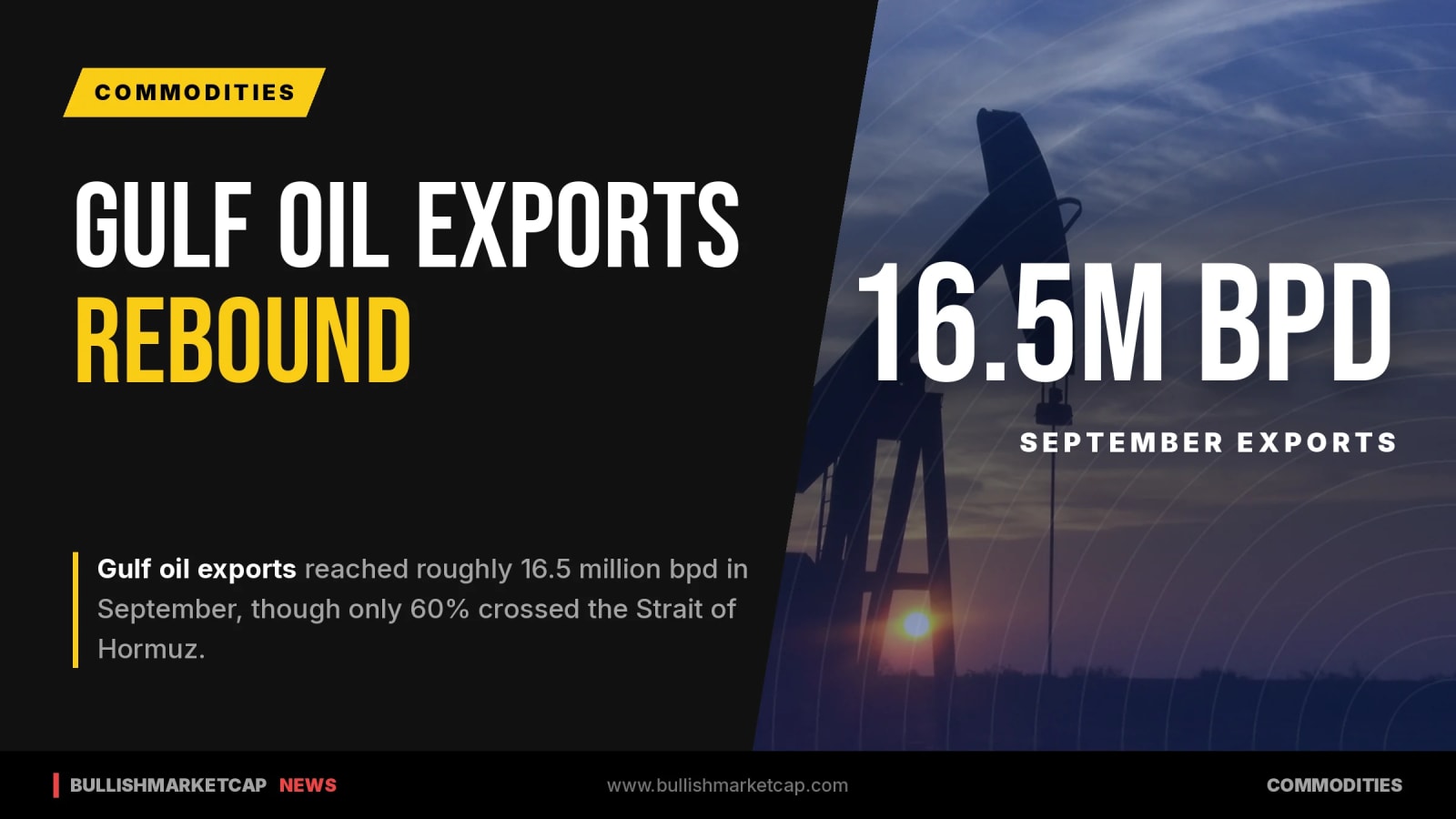
Global crude and condensate export volumes from the Gulf, excluding Iran and including bypass routes such as Fujairah and the Red Sea, reached roughly 16.5 million barrels per day (bpd) in September, broadly recovering to pre-war volumes according to OilPrice. However, traffic through the Strait of Hormuz remains well below normal, with only 60% of those barrels crossing the strait compared with 83% before the conflict.
Logistical Workarounds and Rising Costs
Instant Telegram notifications for large on-chain moves.
Exporters have adapted to the disruption by utilizing pipelines, bypass ports, and extensive ship-to-ship (STS) transfers. Shuttle tankers are increasingly moving crude through Hormuz before transferring cargoes to larger vessels in the Gulf of Oman, while exporters also rely more heavily on the southern route along the Omani coast. Standard Chartered notes that the system is more expensive, inefficient, and increasingly stretched, with STS capacity appearing saturated, voyage times lengthened, and both freight and security costs remaining elevated.
Saudi Arabia illustrates both the success and limits of these adaptations. Following damage to the East-West pipeline in early September, Saudi exports shifted sharply to the east coast, rebounding to roughly 6.9 million bpd in September from 2.45 million bpd in August, with 19 Very Large Crude Carriers transiting Hormuz in one week alone. While the restart of the East-West pipeline and Yanbu loadings restored another route to market, pipeline throughput remains below nameplate capacity and workarounds remain costly, with reports of discounts of up to $9 per barrel on cargoes loaded offshore Oman.
Regional Dynamics and Iranian Exports
Meanwhile, seaborne crude exports from Iran fell to near zero in September, down from roughly 1.7 million bpd before the war, following a United States naval blockade. Tehran reiterated that the Strait of Hormuz will remain closed until the United States fulfills seven conditions from a June interim agreement, while Foreign Minister Abbas Araghchi stated that a recent proposal could lead to the reopening of the strait within seven days if Washington accepts Iranian terms.
Key facts
- Gulf crude and condensate exports reached roughly 16.5 million bpd in September, recovering near pre-war volumes.
- Only 60% of September exports crossed the Strait of Hormuz, down from 83% before the war.
- Saudi Arabian exports rebounded to roughly 6.9 million bpd in September from 2.45 million bpd in August.
- Iranian seaborne crude exports fell from approximately 1.7 million bpd to near zero due to a United States naval blockade.
Source: oilprice.com
This article is for information only and is not investment advice. BullishMarketCap news is produced with AI assistance from public sources and reviewed by our editors; see our editorial policy. Spotted an error? Tell us.