Researchers Develop Low-Cost Membrane to Cut Refining Energy
Scientists from KAIST and Georgia Tech have developed a low-cost polymer membrane that separates crude oil at room temperature, potentially slashing refining energy use by nearly 32%.
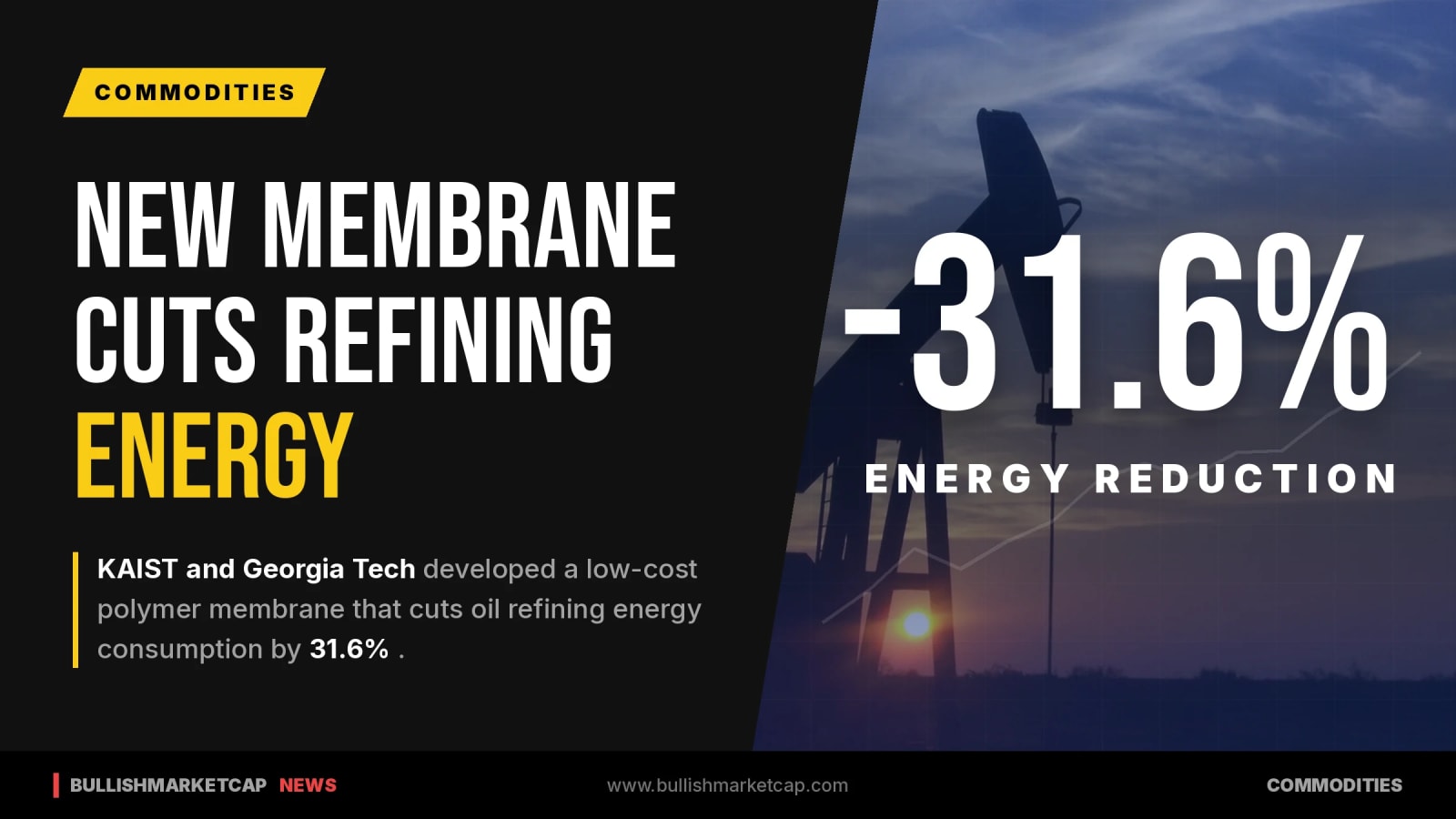
Scientists have developed a low-cost polymer membrane that separates crude oil at room temperature, potentially reducing reliance on energy-intensive refining processes. According to process simulations published in a study this year, the breakthrough could cut refining energy consumption by 31.6%, CO2 emissions by 37.6%, cooling water usage by 20.7%, and operating costs by 36%.
The research was conducted by scientists from the Korea Advanced Institute of Science and Technology (KAIST) and the Georgia Institute of Technology. Instead of relying on an ultra-thin specialized coating like previous membrane attempts, the team passed crude oil directly through a bare porous polyacrylonitrile (PAN) membrane, which is a chemically stable and inexpensive polymer commonly used as an industrial support material.
Instant Telegram notifications for large on-chain moves.
Membrane Mechanism and Performance
When crude oil passes through the bare PAN membrane at room temperature, heavy hydrocarbons selectively stick to the pore walls, turning the membrane into a clogged filter. This accumulation gradually narrows the pores and creates separation channels smaller than 2 nanometers. The setup delivered crude oil permeation rates approximately 23 times higher than previous state-of-the-art crude oil membranes while maintaining stable performance for 28 consecutive days.
Refineries could adopt the technology through relatively simple retrofits by adding a modular filtration unit without requiring massive investments. The membranes cannot replace distillation entirely but can be used as a pretreatment step at an early stage to separate fractions without heating crude oil above 350 degrees Celsius from the beginning.
Key facts
- The polymer membrane reduces crude oil refining energy consumption by 31.6% according to simulations.
- Carbon dioxide emissions could be cut by 37.6% and operating costs by 36%.
- The bare PAN membrane achieved 23 times higher crude oil permeation rates than previous technologies.
- The filtration unit operates at room temperature, avoiding the need to heat crude oil above 350 degrees Celsius from the start.
Source: news.google.com
This article is for information only and is not investment advice. BullishMarketCap news is produced with AI assistance from public sources and reviewed by our editors; see our editorial policy. Spotted an error? Tell us.