Quantum Fears Limit Bitcoin Institutional Growth, Says Stacks Founder
Uncertainty surrounding Bitcoin's quantum security could deter risk-averse institutional investors until developers establish a credible upgrade roadmap.
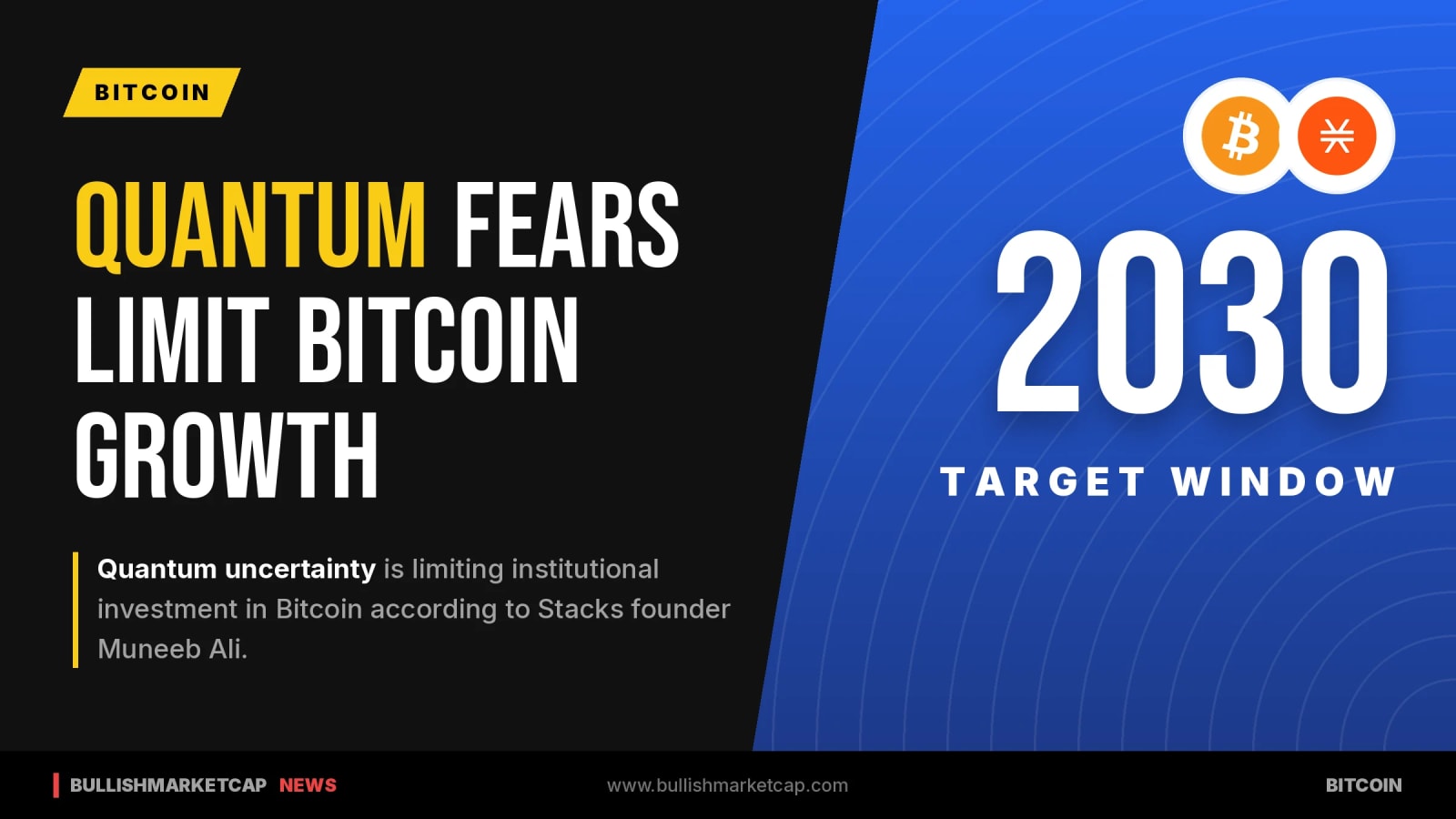
Uncertainty regarding Bitcoin's quantum security is currently imposing a ceiling on institutional growth, according to Stacks founder Muneeb Ali. Speaking on Cointelegraph's Chain Reaction podcast, Ali warned that risk-averse institutional investors may delay large-scale Bitcoin purchases unless developers outline a credible path toward quantum-resistant security measures.
Timelines and Target Dates
Instant Telegram notifications for large on-chain moves.
Ali cautioned that the network could enter a riskier period if meaningful progress is not achieved by 2028, noting that protocol upgrades typically require years of implementation and user migration time. Citing guidance from the US National Institute of Standards and Technology, Ali pointed to 2030 as a target for quantum-resistant transitions, though artificial intelligence advances could accelerate that timeline to 2029.
While some proponents view the quantum threat as distant, Ali argued that disagreements over urgency could erode investor confidence. He suggested that sufficiently powerful quantum computers would likely emerge from major research laboratories such as Google or Microsoft rather than malicious actors with steal-incentives due to legal consequences.
Technical Mitigations
Developers are actively exploring defensive measures. StarkWare reported that researchers reduced the estimated computing cost of an experimental quantum-resistant Bitcoin transaction by 79% following an optimization challenge in September. The approach requires no consensus rule changes but remains a benchmark test, with StarkWare describing it as a last-resort measure alongside protocol-level upgrades.
Key facts
- Growth Impact: Quantum fears create a ceiling on institutional Bitcoin investments, according to Stacks founder Muneeb Ali.
- Target Window: Ali highlighted 2030 as a NIST-guided target for quantum resistance, potentially shifting to 2029 via artificial intelligence advances.
- Cost Reduction: StarkWare researchers cut experimental quantum-resistant transaction computing costs by 79% in benchmark tests in September.
Source: cointelegraph.com
This article is for information only and is not investment advice. BullishMarketCap news is produced with AI assistance from public sources and reviewed by our editors; see our editorial policy. Spotted an error? Tell us.