
Vitalik Buterin Tests Privacy-Focused AI Setup With Tor and zkAPI
Ethereum co-founder Vitalik Buterin is testing a private AI configuration utilizing a local Qwen model, zkAPI, and Tor routing for personalized health advice.
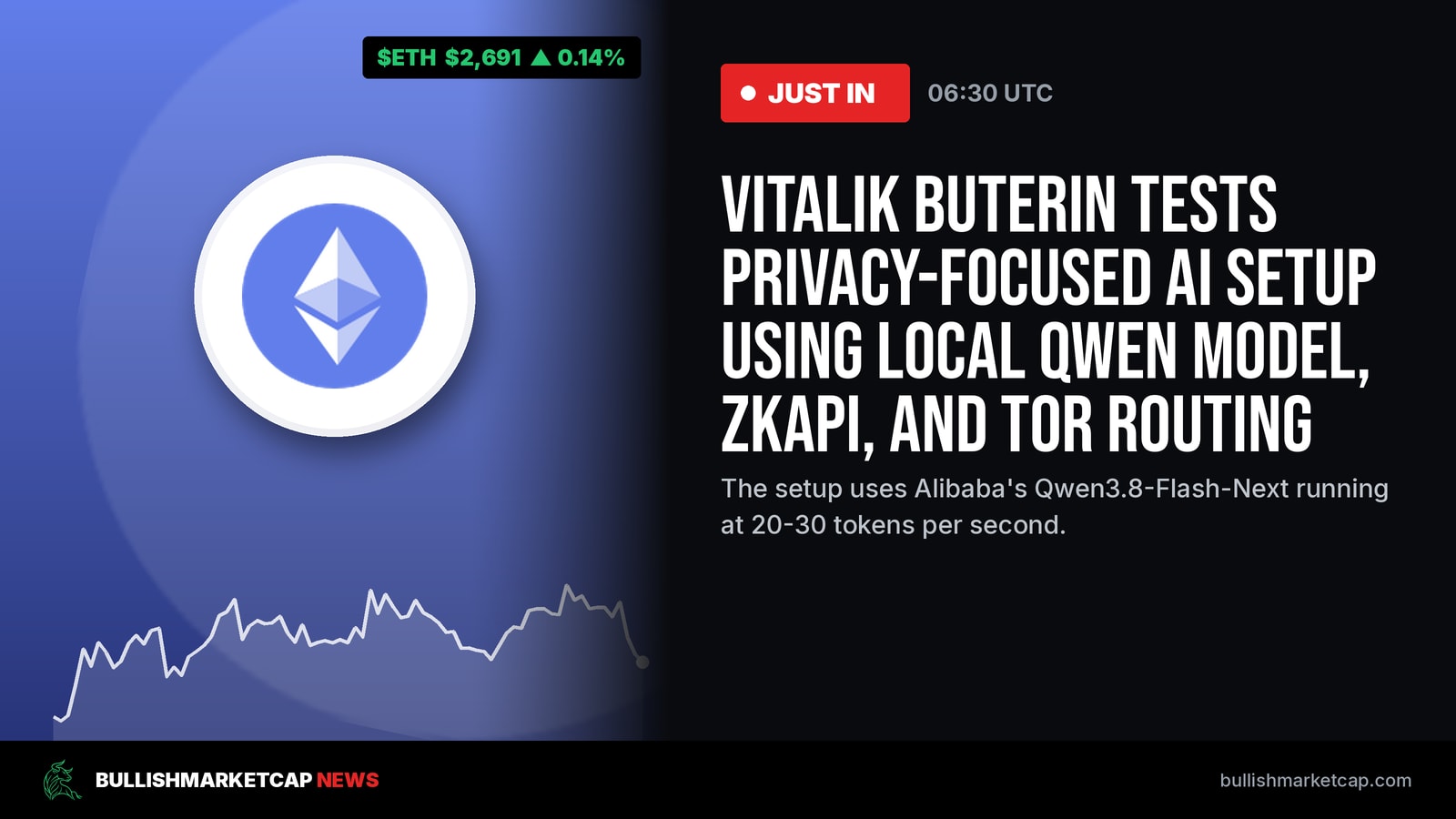
Ethereum co-founder Vitalik Buterin has tested a privacy-focused artificial intelligence setup that combines a local model, zkAPI, and Tor routing to generate personalized diet and exercise recommendations while limiting data sent to remote systems, according to CryptoNews.
The experimental setup uses Alibaba's Qwen3.8-Flash-Next as the local model, which runs at approximately 20 to 30 tokens per second. Buterin's local system decides what information a remote model requires and rewrites requests before transmission, reducing the risk that personal details or writing patterns reveal his identity. Powerful remote models then handle selected questions requiring deeper reasoning.
Instant Telegram notifications for large on-chain moves.
Three-Layer Privacy Architecture
Buterin described the design as a three-layer privacy framework covering request content, payment information, and internet traffic. The local Qwen model manages the first layer by constructing queries instead of transmitting original wording and full personal context.
The second layer utilizes zkAPI, a system introduced by the Ethereum Foundation on Oct. 1 and built by the Open Anonymity Project, running on the Ethereum mainnet. zkAPI separates payment identity from individual AI requests, allowing users to fund a private balance and prove sufficient funds exist without linking specific deposits to requests.
Tor provides the third layer by masking the user's IP address. Buterin noted that all three protections are necessary because hiding payment information alone does not prevent an AI provider from learning details through prompt content or network metadata.
Performance Challenges
Despite the privacy protections, Buterin identified performance bottlenecks in the current configuration. Tor routing introduced latency roughly 10 to 100 times higher than desired, making request-by-request unlinking inefficient. Pull request #16 in the Ethereum zkAPI repository proposes Tor-routed client support with adjusted timeouts, though it has not yet been merged into the main branch.
Additionally, Buterin noted that local inference speeds of 20 to 30 tokens per second fall short of his target of over 100 tokens per second for a comfortable user experience.
Key facts
- Vitalik Buterin tested a private AI setup using a local Qwen model, zkAPI, and Tor.
- The local Qwen3.8-Flash-Next model operates at 20 to 30 tokens per second.
- zkAPI was introduced by the Ethereum Foundation on Oct. 1 to separate payment identity from requests.
- Tor routing introduced latency 10 to 100 times higher than desired in current testing.
Source: crypto.news
This article is for information only and is not investment advice. BullishMarketCap news is produced with AI assistance from public sources and reviewed by our editors; see our editorial policy. Spotted an error? Tell us.