Vitalik Buterin Backs EIP-8288 to Aggregate Ethereum Proofs
Ethereum co-founder Vitalik Buterin endorsed draft proposal EIP-8288 to combine cryptographic proofs off-chain and lower block data demands.
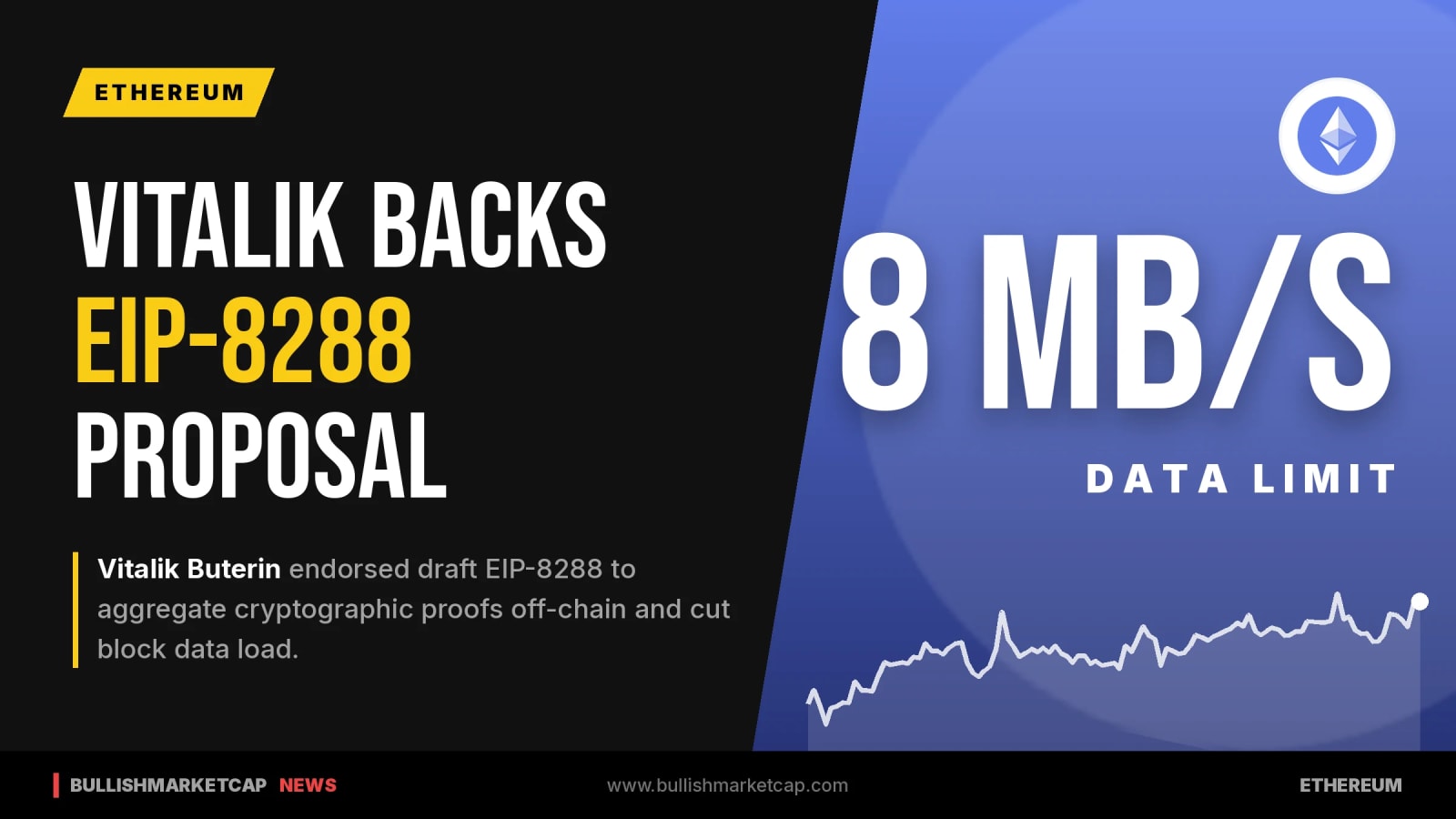
Ethereum co-founder Vitalik Buterin has expressed support for EIP-8288, a draft Ethereum Improvement Proposal aimed at handling complex cryptographic verifications off-chain to reduce data burdens on the primary network. In a series of October 19 posts on X, Buterin argued that Ethereum’s main execution environment and specialized precompiles are not designed to accommodate every new signature or zero-knowledge proof system directly.
Aggregating Cryptographic Proofs Off-Chain
Instant Telegram notifications for large on-chain moves.
Co-authored by Buterin and Ethereum researcher Thomas Coratger, EIP-8288 introduces in-mempool signature and proof aggregation. The mechanism allows transactions to declare required cryptographic verifications without embedding full original proof material inside Ethereum blocks. Users generate signatures and STARK proofs locally, which are then combined recursively into a single aggregated proof verified by network validators using Lean Ethereum tooling.
According to CryptoNews, Buterin noted that publishing large original proofs directly as transaction calldata creates practical data constraints. He estimated that even with scaling improvements like PeerDAS and blocks-in-blobs, the network would face engineering limits at roughly 8 megabytes per second before data processing becomes difficult.
Supporting Post-Quantum Security
The proposal specifically addresses the significant data overhead associated with quantum-resistant cryptography. Under current parameters, hash-based signatures require approximately 2 to 3 kilobytes of data and 150,000 to 200,000 gas to verify directly, while STARK proofs can reach between 128 and 512 kilobytes. By aggregating these dependencies before block inclusion, EIP-8288 aims to support post-quantum signature schemes without inflating execution costs.
EIP-8288 remains a draft specification and has not been approved for mainnet deployment.
Key facts
- Vitalik Buterin endorsed draft proposal EIP-8288 for off-chain proof aggregation.
- The proposal enables recursive STARK proof combining to minimize on-chain data load.
- Hash-based quantum signatures require 2–3 KB and up to 200,000 gas to verify directly.
- Buterin estimated Ethereum faces practical engineering limits around 8 megabytes per second.
- EIP-8288 remains in draft status and requires developer consensus before deployment.
Source: crypto.news
This article is for information only and is not investment advice. BullishMarketCap news is produced with AI assistance from public sources and reviewed by our editors; see our editorial policy. Spotted an error? Tell us.