IMF Finds Tokenized Stocks 1.5 Times More Volatile
IMF research reveals tokenized equities are 1.5 times more volatile and less liquid than traditional shares, with 80% of trades involving fractional amounts.
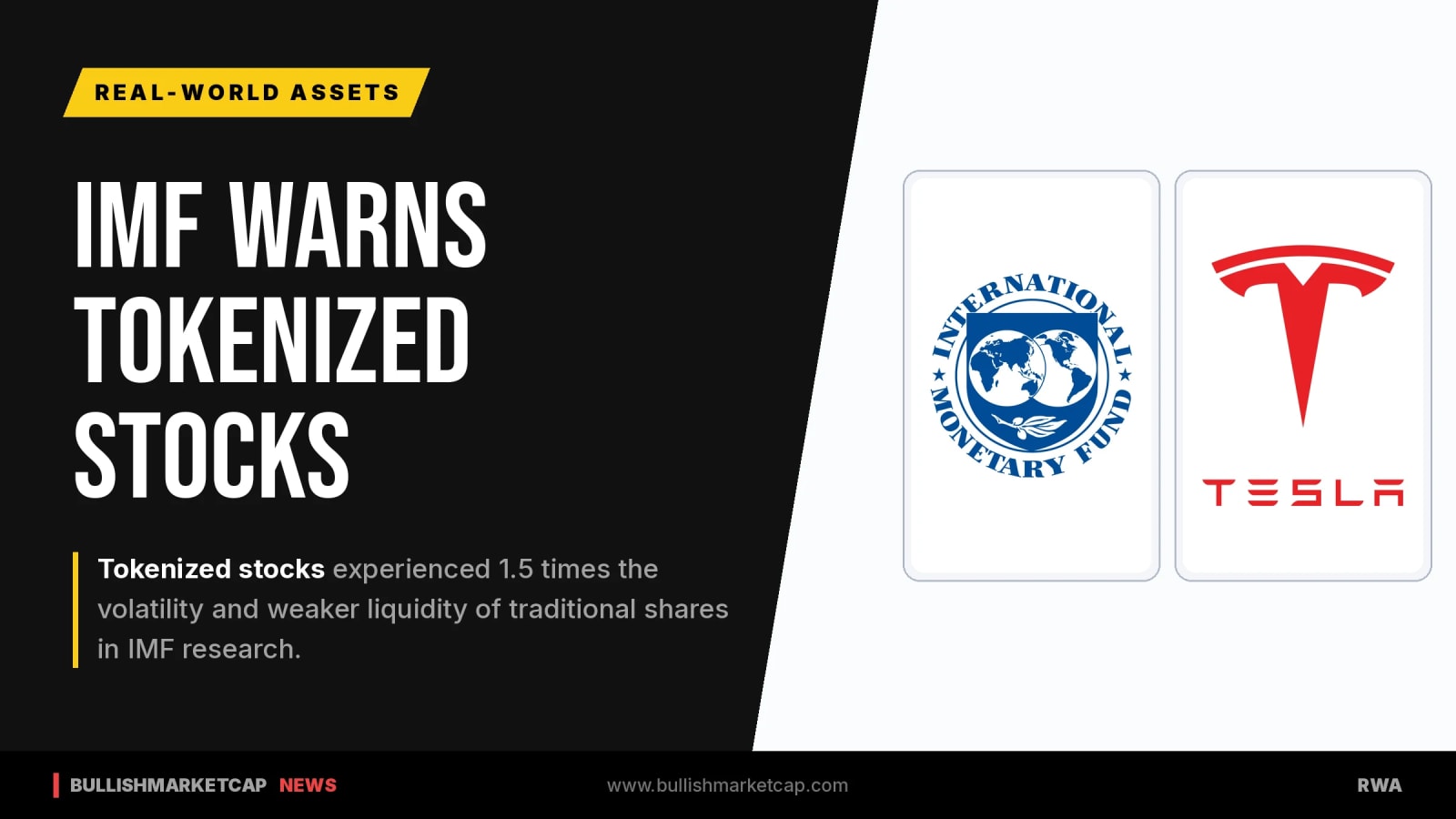
Tokenized stocks experienced approximately 1.5 times the volatility of traditional shares, according to research published by the International Monetary Fund. The study, titled Scaling Tokenization: New Efficiencies, New Vulnerabilities, examined trading data from centralized and decentralized platforms as part of Chapter 3 of the October Global Financial Stability Report.
Market Activity and Fractional Demand
Instant Telegram notifications for large on-chain moves.
The IMF study examined five actively traded tokenized equity products covering Tesla, Nvidia, Alphabet, the S&P 500, and Nasdaq-linked exposure, utilizing approximately $345 million in tokenized equity value across 11 trading venues. Researchers found that over half of tokenized stock trading occurred outside regular United States market hours, driven by investors operating in different time zones and those reacting to developments while conventional exchanges were closed.
Additionally, approximately 80% of examined tokenized equity trades involved quantities smaller than one conventional share, highlighting strong demand for fractional ownership among individual investors. The public tokenized real-world asset market reached approximately $65 billion as of July, with tokenized equities accounting for $2.3 billion. Ondo Finance and Backed Finance were identified as leading issuers, accounting for more than 70% of the estimated market value of tokenized stocks.
Liquidity and Price Discrepancies
While the figures demonstrated continuous demand, the IMF identified challenges regarding market quality. Tokenized equities showed approximately 1.5 times the realized volatility of equivalent stocks traded through traditional exchanges. Decentralized exchanges recorded the highest volatility, followed by centralized cryptocurrency exchanges and traditional stock markets.
Researchers found that trades moved prices more sharply on tokenized platforms because fewer market participants were available to absorb orders. Decentralized venues recorded larger and more frequent pricing differences due to weaker liquidity. To address these vulnerabilities, researchers recommended clearer ownership rules, compatible settlement systems, stronger liquidity safeguards, and improved market oversight measures.
Key facts
- Tokenized stocks exhibited roughly 1.5 times the volatility of traditional shares, according to IMF findings.
- More than 50% of tokenized equity trading occurred outside regular U.S. stock market hours.
- Approximately 80% of examined tokenized equity trades involved quantities smaller than one conventional share.
- The public tokenized real-world asset market reached approximately $65 billion, with tokenized equities representing $2.3 billion.
Source: crypto.news
This article is for information only and is not investment advice. BullishMarketCap news is produced with AI assistance from public sources and reviewed by our editors; see our editorial policy. Spotted an error? Tell us.